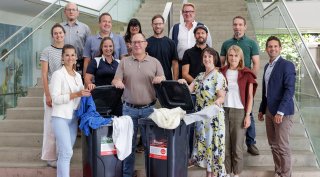
Using AI to combat the flood of textiles: Saubermacher is researching a smart sorting solution for old textiles
The project is being implemented in collaboration with TU Graz, AIT Austrian Institute of Technology, the Styrian technology company KNAPP, Bernhard Binder Mechatronics & Automation and Resolut Consulting. At Saubermacher’s ‘Technikum’ in Puchstraße in Graz, used textiles are first analysed and classified using AI. Well-preserved old clothes are to be automatically sent for reuse, while damaged textiles are to be sent for possible recycling. The aim is to reduce the amount of manual sorting required and give items such as trousers and T-shirts a second life. Thanks to deep learning algorithms, the process is being gradually optimised as it runs. The goal is to develop a scalable sorting system that will serve as the basis for future industrial applications. In this way, the partners are making an important contribution to reducing textile waste and conserving resources.
Growing quantities of old textiles: automation as a useful addition
Numerous new legal requirements – such as the mandatory separate collection of old textiles – and rapidly increasing quantities of textile waste call for swift action. According to the European Commission, around five million tonnes of clothing are disposed of annually across the EU. Only one per cent of this is recycled. Manual sorting by charitable organisations remains an indispensable part of the waste textile industry. Supplementary automated systems create additional capacity and help to keep existing structures fit for the future and efficient.
Hans Roth, founder of Saubermacher: ‘Since Saubermacher was founded, our aim has been to conserve resources and close cycles with innovative solutions. With ReUseTex, we are taking an important step towards a sustainable textile industry. Together with strong partners, we are developing systems that increase efficiency and transparency, paving the way for an environment worth living in.’
Astrid Arnberger, Head of Research & Development, Saubermacher: ‘Over the past 15 years, textile production has doubled, while the lifespan of clothing has fallen sharply. This results in around 114 million tonnes of textile waste worldwide every year – at the same time, interest in second-hand fashion is growing. Saubermacher develops innovative technologies to proactively shape the transition to a circular fashion industry as a reliable partner.’
Selina Möllnitz, Senior Project Manager, Bernhard Binder Mechatronics & Automation: ‘Every second, a truckload of textiles ends up in landfills – efficient sorting systems are currently still lacking. That’s why we are proud to be working on an innovative solution for efficient textile recycling in the ReUseTex project.’
Horst Possegger, Institute of Visual Computing, Graz University of Technology: ‘The development of an AI-supported system that automatically analyses and classifies old textiles combines innovative computer vision methods with a direct contribution to sustainable resource use. Together with our project partners, we are developing a practical, continuously learning and scalable sorting process that paves the way for future industrial applications.’
Alexander Eckert, Project Manager at the AIT Austrian Institute of Technology: ‘In the ReUseTex project, we are contributing our expertise in innovative image capture and image processing technologies, enabling the recognition and classification of used textiles. In doing so, we are laying the foundation for automated sorting in textile recycling. We are proud to be making an important contribution to the circular economy in this area as well.’
Bernhard Pürschl, Global Portfolio Manager Mechatronics, KNAPP AG: ‘The ReUseTex research project combines logistics automation and digitalisation using state-of-the-art technologies – from robotics to AI. As a value chain tech partner, we are also committed to this and are thus making a decisive contribution to a more sustainable future.’
Walter J. Thomsen, Resolut Consulting: ‘It is our task today to develop modern processes that enable the intelligent and efficient sorting of used textiles in order to serve the second-hand market on the one hand and, on the other hand, to return valuable textile waste to the cycle as secondary raw materials so that it can be recycled. ReUseTex is an important step towards achieving this goal.’
The ReUseTex project is funded by the BMIMI and the FFG. The FFG is the central national funding organisation and strengthens Austria’s innovative power.
press release (DE)
Contact
For press inquiries please contact: