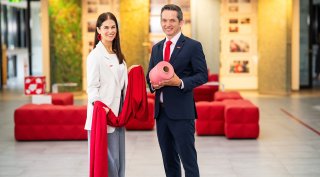
Used textiles back on the runway: Saubermacher showcases textile recycling at VIENNA FASHION WEEK.26
According to a calculation by the Boston Consulting Group, approximately 13.3 million tons of post-consumer textile waste were generated in Europe in 2025. That amounts to about 25 kilograms per person.1 The obvious consequence of this is that wearable clothing should be reused for as long as possible. But even the highest-quality textiles eventually reach the end of their life cycle. Recycling solutions are then needed to turn clothing that can no longer be worn back into raw materials. There is a massive need to catch up in this area, as currently less than 1 percent of the global fiber market comes from fiber-to-fiber recycling.2
Material-specific sorting as the bottleneck: Crucial for the recycling process
Used textiles often consist of different fibers and material blends. Only after determining the material composition and color the appropriate recycling method can be identified and the type of secondary raw material that can be produced from them can be established. Sorting remains the bottleneck in textile recycling: Currently, textiles are sorted almost exclusively into reusable and non-reusable categories, with virtually no material-specific sorting taking place. However, the more precisely textiles are sorted by type of material, the more effectively suitable textiles can be prepared for further processing. While not every fiber is appropriate for creating new yarn, lower-quality fibers can still be reused in so-called open-loop applications—such as automotive accessories, insulation materials, furniture, or acoustic panels. The ultimate goal is fiber-to-fiber recycling: in this process, suitable used textiles are transformed back into raw materials for new textiles. Saubermacher is driving this closed-loop approach forward with innovative projects and products, thereby transitioning from a collector and disposer to a producer of new raw materials.
Textile recycling needs strong partners
However, collection, sorting, processing, fiber recycling, and the production of new fabrics require different areas of expertise. Saubermacher is therefore working with partners to develop and test new recycling methods for textiles that can no longer be used. In projects such as those with Kastner & Öhler, Gigasport, Mode Roth3 and SALESIANER, as well as in the StraTex3 and ReUseTex4 research projects, approaches for collection, sorting, material identification, and processing are being tested. For fiber-to-fiber recycling, Saubermacher is also collaborating with Refibertech. This specialized partner from Portugal processes textile waste into recycled fibers, yarns, and fabrics. Saubermacher aims to close a critical gap in the textile cycle: the point where reuse ends and used textiles can be transformed back into raw materials. Findings from the ongoing projects are also being incorporated into the planning of a material sorting facility in the greater Graz area. There, textiles that can no longer be used will be automatically sorted by material and color and prepared for further recycling processes.
Fashion does not end. It begins anew.
The result of Saubermacher’s pioneering work will be showcased on September 18 on the runway at VIENNA FASHION WEEK.26 in the form of designs by Gabriele Rigby (fashion label FRÖHLICH). Sorted and processed fibers from used clothing will be reworked into fabric together with new fibers. A panel discussion titled “Fashion does not end. It begins anew.” will set the tone for the fashion show. The panelists are:
- Nunu Kaller, textile expert and fair fashion activist, THINK kallerful
- Andreas Opelt, CEO Saubermacher
- Tércio Pinto, Impetus Group
- Gabriele Rigby, designer, fashion label FRÖHLICH
The discussion will be moderated by actress and environmental activist Lilian Klebow (SOKO Donau, Dancing Stars). The focus will be on the question of what conditions are necessary for large-scale textile recycling and how individual pilot projects can evolve into recycling cycles. VIENNA FASHION WEEK.26 thus demonstrates on a small scale what should be achieved on a large scale: viewing used textiles not as an end point, but as a raw material for something new. Together with its partners, Saubermacher is taking responsibility where the fabric cycle still too often comes to a halt today—so that used textiles can be turned back into new textiles.

Andreas Opelt, CEO Saubermacher: “Our goal is to ensure that as many unusable textiles as possible are sent for material recycling. For that we want to lay the groundwork today and put solutions into practice. Those who develop new recycling pathways, build partnerships, and invest in infrastructure are taking on responsibility—but also risk. For this initial investment to evolve into a functioning market, we therefore need reliable rules and fair conditions for everyone.”
Eva-Maria Wurzer, Business Development Textiles Saubermacher: “Textile recycling is a team effort. There does not exist a single technology that can turn every piece of used textile back into a new garment. The key is to correctly identify materials and find the right next recycling step for each category. Our goal is to return as many textiles as possible to textile applications in order to manage the large quantities of used textiles.”
1Boston Consulting Group, “Advancing textile circularity. Europe’s textile waste surge: The case for system-level scale-up” (2026): https://circulareconomy.europa.eu/platform/en/knowledge/advancing-textile-circularity-europes-textile-waste-surge-case-system-level-scale
2Textile Exchange, Materials Market Report 2025 (2025): https://textileexchange.org/knowledge-center/reports/materials-market-report-2025/
3The “Stoff für die Zukunft” project was implemented as part of StraTex. StraTex is a research project aimed at developing sorting and processing strategies for used textiles, with the goal of converting mixed, non-reusable textiles into fractions suitable for material recovery and thereby creating new avenues for high-quality textile recycling. This project is funded by the FFG. The FFG is the central national funding organization and strengthens Austria’s innovative capacity.
4The ReUseTex project is funded by the Federal Ministry of Innovation, Mobility and Infrastructure and the FFG.
press release
Contact
For press inquiries please contact: