Saubermacher at VIENNA FASHION WEEK.26: What textile recycling now needs
There is a great need for action: According to the Boston Consulting Group, approximately 13.3 million tons of post-consumer textile waste were generated in Europe in 2025—about 25 kilograms per person.[1] At the same time, less than one percent of the global fiber market currently comes from fiber-to-fiber recycling.[2] The gap between the available used textiles and their use as raw materials for new textiles therefore remains significant.
Where fashion takes center stage, textile recycling belongs on the runway
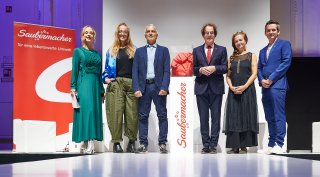
VIENNA FASHION WEEK.26 provided the ideal stage. Together with designer Gabriele Rigby (FRÖHLICH), Saubermacher demonstrated how new fabrics for the runway can be created from processed recycled fibers. In the accompanying talk “Fashion Doesn Not End. It Begins Anew.” fair fashion activist Nunu Kaller, Saubermacher CEO Andreas Opelt, textile recycler Tércio Pinto from Refibertech, and Gabriele Rigby—moderated by actress and activist Lilian Klebow—discussed the prerequisites for functioning textile cycles. The focus was on product design, sorting and recycling technologies, and the necessary regulatory framework for expanding the infrastructure.

Clear rules for greater investment security
The discussion made it clear: Scaling up textile recycling requires reliable rules. Many of the necessary steps—product design that facilitates recycling, extended producer responsibility, and the expansion of sorting and recycling capacities—are already outlined in the EU Textile Strategy. Implementation is now key: For textile circularity to function on a large scale, all stakeholders must do their part. Manufacturers are called upon to consider textile recyclability right from the start—in design, material selection, and product development. Retailers and consumers play an important role in returns, collection, conscious consumption choices, and reuse. The recycling industry, in turn, must provide suitable sorting and processing solutions for those textiles that can no longer be reused. At the same time, investment security and fair competitive conditions are needed so that companies that invest in appropriate solutions early on are not put at a disadvantage.
Thinking about the future of textiles today
Saubermacher is working with partners from the fields of research, retail, textile production, and recycling to close gaps in the textile cycle. One focus is on material sorting: Only once the composition and color have been reliably identified can the appropriate recycling pathway be determined. Findings from ongoing projects are being incorporated into the planning of a material sorting facility in the greater Graz area. There, textiles that can no longer be used will in the future be automatically sorted by material and color and specifically prepared for different recycling pathways. The goal is to develop robust structures for larger volumes based on individual projects.
[1] Boston Consulting Group, “Advancing textile circularity. Europe’s textile waste surge: The case for system-level scale-up” (2026): https://circulareconomy.europa.eu/platform/en/knowledge/advancing-textile-circularity-europes-textile-waste-surge-case-system-level-scale
[2] Textile Exchange, Materials Market Report 2025 (2025): https://textileexchange.org/knowledge-center/reports/materials-market-report-2025/
[3] Among other things, the EU Textile Strategy calls for all textiles placed on the market in the EU by 2030 to be durable, repairable, and recyclable, and to be made largely from recycled fibers. Read more: EU Textile Strategy
Excerpts from the talk “Fashion Does Not End. It Begins Anew.”:
Nunu Kaller, textile expert and fair fashion activist, THINK kallerful: “Major fast fashion companies often advertise using recycled materials. However, in most cases, this involves downcycling from PET bottles or similar sources. Less than one percent of used clothing is actually recycled. The biggest challenge here isn’t the recycling process itself, but sorting used clothing according to its material composition. That’s exactly where Saubermacher comes in. Saubermacher’s projects and plans could be a real game-changer in Europe. It’s great to see a pioneer in the fight for a cleaner fashion world coming from Austria!”
Andreas Opelt, CEO of Saubermacher: “Concrete technical solutions for textile recycling already exist. The key now is to create the conditions necessary for a functioning market to emerge. To achieve this, companies need ambitious regulations that promote the circular economy—and with them, planning certainty, reliable framework conditions, and fair competitive conditions. At the same time, all stakeholders along the value chain must do their part—from manufacturers and designers to recyclers.”
Tércio Pinto, Refibertech: “Just as other companies have their own suppliers, the textile recycling sector also needs a new player in the market: waste management companies that provide us, as recycling facilities, with sorted and processed used textiles, which we can then turn into new fibers. The necessary laws already exist within the EU—national governments must now implement them quickly so that new initiatives in the field of textile recycling are actively promoted.”
Gabriele Rigby, designer at the fashion label FRÖHLICH: “For me, two aspects have always been central to my design work: Clothing should feel good, be comfortable, and be suitable for everyday wear. At the same time, it’s important to me to make sensible use of existing resources rather than constantly consuming new ones. Recycled materials combine exactly these qualities. They’re soft, comfortable to wear, and work very well in production.”
Impressions
Print-quality photos are available on Picdrop (© Saubermacher/Sabine Klimpt): Saubermacher Fashion Week Press
press release
Contact
For press inquiries please contact: