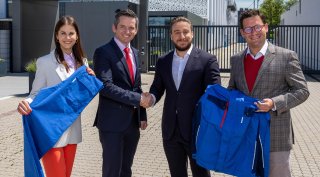
Saubermacher and SALESIANER: Raw materials from laundry piles
Mixed materials, wear and tear, and soiling make it difficult to recycle used textiles from the professional laundry sector. At the same time, these textile streams offer a key advantage: they are available in regular, predictable quantities, with high transparency regarding material types and usage cycles. This is precisely where the joint pilot project between Saubermacher and SALESIANER comes into play. The goal of the twelve-month initiative is to develop and test a closed or partially closed textile loop.
Less waste incineration, more material recycling
The focus is on the potential inherent in textiles of varying quality and how this potential can be best harnessed. SALESIANER contributes direct access to used textiles as well as comprehensive expertise on material types, product information, and usage cycles. Saubermacher is responsible for evaluating the textiles, sorting and identifying materials, as well as coordinating recycling and reuse options. Reuse—that is, the repeated use of textiles—naturally takes priority in the context of the circular economy, but is only possible to a limited extent with commercial textiles. Therefore, the focus is equally on evaluating the possibilities of processing the materials into new textiles and on their use in products outside the textile industry. This is because not every material can be processed into a new textile, making it all the more important to identify alternative material recovery pathways beyond incineration.
Identifying new uses for used textiles
Another key focus of the pilot project is to identify potential markets for recyclable textile fractions. Not every material is suitable for the same recycling pathway. While used textiles of certain qualities can be reintroduced into textile applications, other fractions offer potential for open-loop applications¹. The insights gained are intended to serve as the basis for potential scaling and market launch. At the same time, the project aims to provide impetus for industry and commerce: materials currently in circulation can be transformed into new raw materials—provided that suitable applications and consumer markets are considered early on. Furthermore, close collaboration with industry opens up the possibility of incorporating “design for recycling” approaches right from the development stage of new textile products.
1Open-loop solutions refer to the reuse of fiber grades that are not suitable for yarn production. These include product categories such as automotive components, insulation materials, furniture, and acoustic panels.
Andreas Opelt, CEO Saubermacher: “Our goal is to divert as many used textiles as possible to material recycling and thereby demonstrate new approaches beyond thermal recycling. This requires reliable data, strong partnerships, and the courage to rethink existing materials. Together with SALESIANER, we are laying an important foundation for testing and further developing practical recycling solutions for commercial textile streams.”
Eva-Maria Wurzer, Business Development Textiles Saubermacher: “Rental textiles from the professional laundry sector represent a particularly promising stream of raw materials for the circular economy: The steady, predictable volume of these textiles creates ideal conditions for efficiently implementing recycling solutions. We want to understand which qualities are suitable for which applications and where new consumer markets might emerge. This is exactly where the pilot project comes in: It highlights potential and invites the industry to actively help shape the circular economy.”
Phillip-Sebastian Marchl, COO SALESIANER Austria: “Commercial textiles have long lifecycles and high quality standards. This makes it all the more important to develop sustainable solutions for the end of their lifecycle. With this pilot project, we aim to lay a solid foundation for a functioning circular economy for textiles.”
Mathias Nell, Head of Sustainability & Grants SALESIANER: “Textile recycling is one of the key issues for the future of the European circular economy. The goal of the project is to develop reliable data and practical models for future scaling.”
Press release
Contact
For press inquiries please contact: