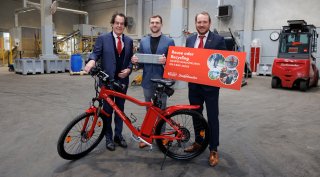
Reuse or Recycling: Saubermacher and Liofit rescue e-bike batteries
There are currently over 1 million e-bikes in use on Austria’s roads (klimaaktiv). In Germany, the figure is already just shy of 16 million (ADFC). At the heart of these bikes are lithium-ion batteries. Under the EU Battery Regulation, these must be removable and replaceable from 2027 onwards. The joint initiative by Saubermacher and Liofit is therefore set to have a solid legal basis in future. The two partners are working at the Saubermacher site in Premstätten to keep e-bike batteries functional and in circulation for as long as possible.
Reuse, Repair or Recycling
The transfer of expertise is the top priority here. In future, it should be possible to assess the quality of and pre-sort discarded batteries without opening them, thanks to software from Liofit. This software scans the battery’s label using a mobile phone and automatically cross-references it in the background against a battery database containing around 1,000 different models. If the app gives the ‘green light’, the battery is suitable for potential repair or for the removal of spare parts. Every battery is different and must be individually inspected and dismantled. To this end, the database provides practical video tutorials and training. It also sets out clear criteria for spare parts recovery and instructions for potential repairs. Only when recycling of the entire battery or individual parts is no longer possible does the app give the ‘red light’, and the battery goes straight to recycling.
Good for both the environment and your wallet
Second Life pays off: A comparison between repairing and buying a new 500 Wh e-bike battery shows that avoiding the energy- and material-intensive process of manufacturing a new battery can save around 16 to 30 kilograms of CO₂ equivalents (Umweltbundesamt.de). The approach also makes economic sense: a new high-quality battery can cost more than €1,000. A repair is significantly cheaper. If, for example, the cell pack – the heart of the battery – is replaced, the cost is a maximum of €500; many faults can be rectified for less than €200. A repair can double the battery’s lifespan. As part of the initiative, 4,000 e-bike batteries have already been assessed at Saubermacher’s Premstätten site. According to the diagnosis, around 60 per cent of these can be put to potential reuse or, alternatively, used as a source of spare parts.
CEO Liofit, Rico Günther: “Many e-bike batteries deserve a second chance, but end up at the recycling centre before their time. This is where our partnership with Saubermacher comes in. We combine our expertise in repair and development with Saubermacher’s recycling expertise. This allows batteries to be assessed more quickly and put to good use. It saves time, resources and money.”
Founder of Saubermacher, Hans Roth: “Reuse projects play a key role in achieving our vision of zero waste. At the same time, through our joint initiative with Liofit, we are contributing to sustainable mobility and supporting the growing importance of cycling in everyday life.”
VP Batteries Saubermacher, Thomas Haid: “Working with Liofit, the European market leader, enables us to make data-driven decisions regarding reuse or recycling, build up targeted repair expertise, and keep materials in circulation for longer.”
press release
Contact
For press inquiries please contact: