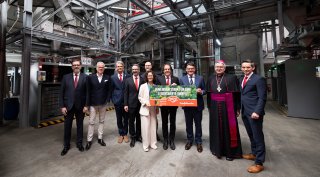
Using AI to reduce dependence on raw materials: Saubermacher and Meinhardt open one of Europe’s most modern battery recycling plants
The joint venture between Saubermacher and Meinhardt has two objectives: the plant is designed to meet the growing demand for the disposal of portable and household batteries. Ultimately, however, the recovery of recycled raw materials from used batteries is also intended to strengthen Europe’s independence from raw material imports. The new treatment process exceeds, in some cases significantly, the recycling efficiency targets set by the European Union’s Battery Regulation. The innovative process is also intended to help reduce dust emissions as well as fire and explosion risks during the processing of used batteries. The plant was constructed at the Ginsheim-Gustavsburg site in accordance with the highest fire safety standards. A 24/7 monitoring, detection and extinguishing system ensures maximum safety, with occupational safety being the top priority.
Varietal purity through AI
The new facility primarily processes standard household batteries – such as traditional AA and AAA batteries used in torches, toys or remote controls. However, more specialised battery types are also recycled, for example those from power tools such as cordless screwdrivers. This is carried out via a highly automated process that achieves a sorting accuracy of over 99 per cent. AI-based systems and X-ray technology identify the specific chemical composition of each battery. This enables the targeted recovery of valuable secondary raw materials contained in the used batteries, such as nickel, iron, zinc or aluminium. Up to 100 per cent of the metals can be sent for recycling. The material flows are recorded digitally throughout the entire process.
Insights into the new facility
Full legal certainty
The recycling plant meets all the requirements of the EU Battery Regulation and the national Battery Act Implementation Act¹. But that is not all: with the implementation of the European List of Waste Regulation, mixed household batteries will in future be classified as hazardous waste in Germany. This significantly increases the regulatory requirements for the collection and treatment of waste batteries: in order to be permitted to process relevant quantities of hazardous waste on-site, classification as a high-risk facility is required. The plant in Ginsheim-Gustavsburg already meets these requirements today. All the necessary permits have been obtained. The project was funded with €1,145,000 from the Environmental Innovation Programme of the German Federal Ministry for the Environment, Climate Action, Nature Conservation and Nuclear Safety.
1 The Battery Act Implementation Act (BattDG), which came into force in October 2025, serves to implement and supplement the EU Battery Regulation in Germany. It is intended to regulate the market behaviour of the parties subject to the BattDG, including take-back, disposal and extended producer responsibility, in order to raise environmental standards.

Boris Rhein, Minister-President of Hesse: “With the opening of the new battery recycling plant, Saubermacher Dienstleistungs AG and Meinhardt Städtereinigung GmbH are demonstrating what is possible when responsibility and progress go hand in hand. The plant is one of the most modern of its kind in Europe and combines innovative sorting technology with the highest safety and environmental standards. This demonstrates that sustainability and economic strength are not mutually exclusive. The two companies are thus making an important contribution to a successful circular economy, greater industrial value creation and a strong business location. The state was therefore happy to provide funding of 700,000 euros.”
Antje von Broock, Federal Ministry for the Environment, Climate Action, Nature Conservation and Nuclear Safety (BMUKN): “The more raw materials we recover from old devices for use in new products, the less dependent we become on international supply chains. Battery recycling is a crucial step towards securing the supply of raw materials in Germany. Consumers play a key role in this: by handing in their batteries at a collection point, they make a valuable contribution to greater raw material security. Old batteries do not belong in the general waste bin! The state-of-the-art facility at the Ginsheim-Gustavsburg site helps to keep many raw materials in a sustainable cycle. At the same time, the innovative recycling process reduces dust emissions and lowers the risk of fire and explosion during the processing of used batteries.”
Hans Roth, founder of Saubermacher: “This new facility proves that we can achieve more by working together. Saubermacher and Meinhardt are demonstrating what it means to pool expertise and thereby enable sustainable, future-proof innovation. By building this plant, we have taken another step towards our ‘Zero Waste’ vision through partnership.”
Andreas Opelt, CEO Saubermacher: “Our new facility stands for quality and safety for our employees and the environment. We aim to bring Europe’s battery recycling processes – some of which are currently lagging behind – up to the latest state of the art. In doing so, we want to reassure battery distributors who place their trust in us that the recycling of their products adheres to the strictest standards, achieves the highest recycling rates, and avoids unnecessary transport journeys across Europe.”
Marco Hastenteufel, Saubermacher Recycling GmbH: “The opening of this facility is a key step towards a scalable circular economy for batteries. We are deliberately investing here in Germany – at a level that meets the highest standards of safety, environmental protection and process quality. It is now crucial that these high standards are reflected in the competitive landscape. Only a reliable and fair market environment will enable us to sustainably develop the urgently needed recycling capacities in Europe.”
Matthias Harms, CEO Strategic Waste Holding/BDE: “Modern recycling facilities like this one strengthen the circular economy and make an important contribution to raw material resilience in Europe. They demonstrate how innovation can help keep valuable materials in circulation and reduce our dependence on imports. Projects like this are an important step towards a more sustainable and resilient economy.”
Torben Kraffczyk, COO Meinhardt Group/Saubermacher Recycling GmbH: “Our cross-border collaboration demonstrates just how innovative small and medium-sized enterprises in the waste management sector are. At the same time, through this project, we are committed to providing our employees with job security and a sustainable future within the Meinhard Group.”

press release
Contact
For press inquiries please contact: