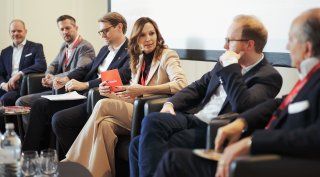
Saubermacher seeks solutions for transformation together with the construction industry
The discussion began with the recent changes introduced by the EU Omnibus Regulation, which have postponed key elements of the CSRD and the EU Taxonomy and watered down their content. The overall tone of the event was that the outlook for the future is fundamentally positive. However, the temporary reduction in bureaucratic requirements does not alter the strategic direction. Sustainability and the circular economy remain key guiding principles for the construction sector. Just last week, the CSRD was transposed into national law with the adoption of the Sustainability Reporting Act by the Austrian National Council. Furthermore, the VSME has established a voluntary EU-wide sustainability reporting standard for small and medium-sized enterprises that are not subject to the statutory reporting obligation but nevertheless wish to provide business partners with sustainability data.
The construction sector is key to achieving climate targets
With around 360,000 employees and a turnover of over €72 billion (2023) [1], the Austrian construction industry remains one of the most important, yet also one of the most resource-intensive, sectors of the economy. Accounting for 73% of the country’s total waste generation (approx. 49 million tonnes), the construction sector was also considered Austria’s largest waste generator in 2023[2]. Circular construction is therefore a key lever for achieving climate targets and reducing dependence on primary raw materials. Anchored in the CSRD and the EU Taxonomy, circularity in construction can be seen as a competitive opportunity despite the increased documentation requirements. Since their entry into force, a uniform, steadily growing and comparable data basis has emerged for the first time. Through targeted digitalisation, companies can harness this potential accordingly.
Investment, housing and skills shortages as bottlenecks
Potential obstacles to intensive construction activity are evident in terms of both finance and manpower: cautious investment due to price rises has led to an increase in unrealised projects across Europe, particularly in residential construction. In the European context, there is a shortfall of at least 1 million housing units. A revival of the market is not expected until 2027 at the earliest. However, this cannot be achieved without skilled workers: around 70% of Austrian companies now report difficulties in recruiting staff. Companies must therefore aim to strike a balance between boosting productivity despite staff shortages. Opportunities lie in the use of artificial intelligence to reduce planning times and error rates, in strengthening staff retention, and in adopting a more holistic recruitment approach that looks beyond Austria’s borders to include, for example, Eastern Europe.

The circular economy needs data, infrastructure and a market
However, reporting to demonstrate a functioning circular economy is only one step along the way. For instance, the EU taxonomy for construction and demolition activities requires that at least 70% of non-hazardous construction and demolition waste be reused or recycled. To achieve this, materials must be properly sorted, documented and specifically recycled during the demolition and construction phases. System service providers such as Wastebox.biz assist with the monitoring and documentation of waste disposal and create the necessary transparency and data basis for taxonomy and reporting requirements. Regulatory-driven transformation is also demonstrated by the recycled gypsum regulation and the landfill ban on plasterboard. With the commissioning of its recycling plant in Stockerau in autumn 2025, GzG Gipsrecycling GmbH, a joint venture between PORR, Saint-Gobain and Saubermacher, has created the first closed-loop gypsum cycle in Austria and established the recycling infrastructure required by law. However, a functioning market is also a key factor in this. Such a market can only develop if the demand for high-quality secondary raw materials increases. However, as long as the use of primary materials remains cheaper, a breakthrough will be difficult to achieve.
Achievable together: Teamwork in the circular economy
What is becoming clear is that, despite regulatory changes, circular construction is not coming to an end. On the contrary, the combination of housing demand, pressure on resources and investors’ focus on ESG makes the circular economy a strategic competitive factor. The interaction between business, politics and regulation is crucial. Circularity in the construction sector does not need lone warriors, but teamwork, as Hans Roth, founder of Saubermacher, confirms: “A circular economy in construction is only possible in collaboration with the industry. As a waste management company, this also requires the courage to innovate. But I am convinced that, together with our partners, we can set the tone on the path to our vision of zero waste.”
[1] Wirtschaftsatlas Statistik Austria, Branchendaten nach Wirtschaftszweigen 2023 (https://www.statistik.at/services/tools/wirtschaftsdaten/wirtschaftsatlas)
[2] Bestandsaufnahme der Abfallwirtschaft in Österreich: Statusbericht 2025 für das Referenzjahr 2023 (https://www.bmluk.gv.at/service/publikationen/klima-und-umwelt/bestandsaufnahme-abfallwirtschaft-statusbericht-2025.html)
press release
Contact
For press inquiries please contact: